
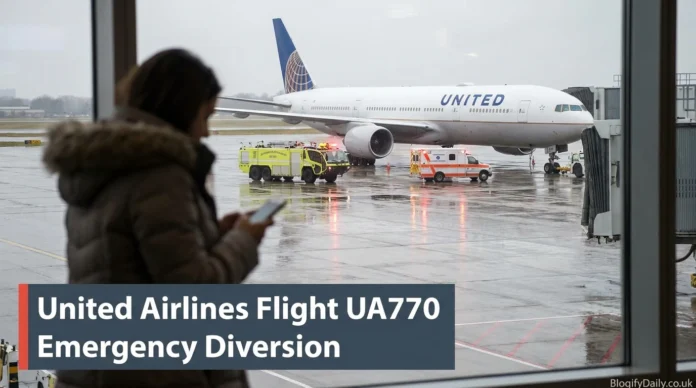
The phrase united airlines flight ua770 emergency diversion points to a real aviation event, but the public record is thinner than many readers may expect. What can be verified is the core incident: United flight UA770, operating from Barcelona to Chicago, declared a general emergency and diverted to London Heathrow on May 27, 2025. Public flight-tracking pages list UA770, and contemporaneous aviation reporting said the aircraft was rerouted after the crew declared an emergency.
That matters because search interest around flight incidents often grows faster than reliable facts do. In cases like this, many articles repeat dramatic claims, but not all of them are backed by strong sourcing. A useful article should separate the confirmed basics from the details that remain unclear.
What happened to United Airlines flight UA770?
The clearest publicly available version is this: United Airlines flight UA770 was traveling from Barcelona to Chicago when it declared an emergency and diverted to London Heathrow. AIRLIVE reported the diversion on May 27, 2025, and said the pilots squawked 7700, which is the standard transponder code used to signal a general emergency. Flight-tracking sources also show UA770 as an active United service with historical tracking data.
The most important point is that a diversion does not automatically mean a crash-level event. In aviation, a crew may divert for a wide range of reasons, including a technical issue, smoke or fumes, a medical problem, a systems warning, or another safety concern that makes continuing to the original destination less appropriate. A 7700 code tells air traffic control that the flight has an emergency, but the code itself does not reveal the exact cause.
What does “squawk 7700” mean?
A lot of readers search this keyword because they see “7700” mentioned in flight-tracking discussions and assume it refers to the flight number. In this case, there are two separate “770” references in the story:
- UA770 is the flight number
- 7700 is the emergency transponder code
That distinction is important. Flightradar24 explains that 7700 is the general emergency squawk used by pilots to alert air traffic control that the aircraft is dealing with an urgent situation. The exact problem may still be mechanical, medical, operational, or safety-related.
So when readers see reports saying UA770 “declared emergency,” that does not by itself confirm engine failure, smoke, fire, cabin depressurization, or any other specific scenario. It confirms only that the crew signaled an emergency and that the flight diverted rather than continuing to Chicago.
What route was UA770 flying?
Available public reporting and later summaries consistently point to the same route: Barcelona to Chicago. AIRLIVE’s contemporaneous report described the aircraft as a United flight from Barcelona heading to Chicago before diverting to Heathrow. Several later recap pages repeat that same route, although those later write-ups vary in how much sourcing they provide.
Because the contemporaneous report and the later summaries align on the route, that part of the story is more dependable than many of the other details circulating online. The route itself is one of the stronger facts in the public record.
Why did United Airlines flight UA770 divert?
This is the part where readers need to be careful.
Some later reports say the diversion involved a technical anomaly or another onboard issue. A social-media snippet surfaced in search results saying the airline confirmed “fumes” in the aircraft’s galley, but that detail does not appear in the most accessible primary reporting on the event, and the available web evidence for it is weaker than the core fact of the diversion itself.
Based on the currently accessible public sources, the safest summary is this:
- An emergency was declared
- The flight diverted to London Heathrow
- The exact publicly documented cause is not fully clear from strong, widely accessible reporting
That may feel unsatisfying, but it is the most responsible way to present the event. When verified detail is limited, it is better to say “unclear” than to turn a possibility into a fact.
Did the plane land safely?
The available reports indicate that the aircraft landed safely at London Heathrow after the diversion. AIRLIVE said the flight was diverting to Heathrow and expected to land there, while later summaries describe a safe landing and no catastrophic outcome. Public interest around the story appears to stem from the emergency declaration and route interruption, not from any confirmed fatal or major injury event.
That distinction matters because search traffic often turns a routine but serious safety response into something more dramatic. An emergency diversion is still a major event for passengers and crew, but it can also be evidence that aviation safety procedures worked as intended. The crew identified a concern, declared the emergency, and headed to a major airport capable of handling the aircraft.
Why London Heathrow?
For a transatlantic flight already operating in European airspace, London Heathrow is an understandable diversion point. It is a major international hub with extensive emergency response resources, airline support infrastructure, maintenance capability, and strong operational capacity for widebody international traffic. While the precise operational reasoning was not fully published, diverting to a major airport instead of continuing across the Atlantic is consistent with how airlines reduce risk when a flight develops a problem before ocean crossing or early in the long-haul phase. This is an inference based on standard aviation practice and Heathrow’s role, not a quoted airline explanation.
Readers should treat this as informed context rather than a confirmed statement from United. Public reporting establishes the diversion to Heathrow, but not a full operational briefing on why that airport was chosen over all others.
What passengers on a diverted flight usually experience
Even when the cause is not fully disclosed, passengers on a diverted international flight often face the same practical issues:
Immediate onboard procedures
When a crew declares an emergency, the first priority is aircraft safety. That can mean a change in route, communication with air traffic control, cabin preparation, and possible priority handling on arrival. A 7700 squawk is part of that emergency-handling framework.
Arrival at the alternate airport
After landing, the airline may keep passengers onboard briefly, move the aircraft for inspection, or begin ground handling, rebooking, and hotel or meal support depending on the situation and delay length. The exact support can vary based on the cause of diversion, country, airport, and onward plan. These general outcomes are consistent with how other United diversion cases have been handled in later 2025 incident reporting.
Delays and missed connections
For a Barcelona-to-Chicago service, a London diversion can disrupt immigration timing, onward connections, baggage arrangements, and overnight accommodation. In real-world travel, the operational disruption often lasts longer than the emergency itself. That is one reason these incidents attract so much online attention even when the landing is safe.
What readers should verify before trusting a report about UA770
This topic is a good example of why aviation stories should be checked carefully.
1. Look for contemporaneous reporting
A same-day or near-real-time aviation report is usually more useful than a later article that seems to summarize other summaries. In this case, the May 27, 2025 AIRLIVE report is closer to the event than many later blog-style articles.
2. Separate the flight number from the emergency code
Many casual readers confuse UA770 with 7700. That can lead to inaccurate retellings. The flight number identifies the service; the transponder code indicates a general emergency.
3. Be cautious with exact-cause claims
If an article says the diversion was definitely due to engine failure, smoke, cabin pressure, or a medical emergency, check whether it cites a direct airline statement, regulator filing, or well-sourced reporting. For UA770, the cause is not as clearly documented in strong public sources as the diversion itself.
4. Use flight-tracking sources as support, not the full story
Flight history tools are useful for route, timing, and diversion confirmation, but they do not always explain the reason behind the emergency in full detail. They are strongest when paired with reporting or official statements.
Highlights / Key Takeaways
- United Airlines flight UA770 did experience an emergency diversion
- The flight was reported as traveling from Barcelona to Chicago
- The crew reportedly squawked 7700, signaling a general emergency
- The aircraft diverted to London Heathrow
- The exact cause is less clearly documented than many online summaries suggest
- Readers should trust the core event, but stay careful with unsupported cause claims
What to check next
If you are researching this incident for accuracy, the most useful next step is to check whether a fuller airline statement, airport record, or regulator note becomes publicly available later. As of now, the best-supported version is the simple one: UA770 declared an emergency and diverted safely to Heathrow, while some finer details remain unclear in the public record.
That may not be the dramatic answer some readers expect, but it is the reliable one. In aviation coverage, a careful article is better than a sensational one.
FAQs
What was United Airlines flight UA770?
United Airlines flight UA770 was a scheduled service publicly reported as operating from Barcelona to Chicago on May 27, 2025, when it declared an emergency and diverted.
Did UA770 make an emergency landing?
Yes. Public reporting says the flight declared an emergency and diverted to London Heathrow, where it landed safely.
What does squawk 7700 mean?
It is the standard transponder code for a general emergency. It alerts air traffic control that the aircraft has an urgent situation.
Why was United Airlines flight UA770 diverted?
The exact cause is not clearly documented in the strongest publicly accessible sources. Some later reports mention a technical issue or fumes, but those details are less firmly established than the diversion itself.
Was anyone hurt on UA770?
The accessible reporting around this event points to a safe landing and does not show strong public reporting of a major casualty outcome.
Why did the flight go to Heathrow instead of Chicago?
The flight diverted because the crew declared an emergency. Heathrow was the alternate airport used. Public sources confirm the diversion, though they do not fully detail the operational decision-making behind that airport choice.

